
The Lunenburg Owner-of-Record Card
ConciseCAMA serves as the Commissioner's online assessment reference. Its parcel card can carry the owner name, mailing address, situs, and map number. Land and improvement values, the legal description, exemptions, and land-use flags appear as well. Sale history and a deed reference round out the display. Treat the card as a checklist of fields to review rather than a certified statement of value. The Commissioner notes that the office record, not the web display, controls.
| Owner name | Assessment roll name, as displayed |
|---|---|
| Mailing address | Destination for tax correspondence, not occupancy |
| Situs | Physical property location |
| Map number | Parcel key to retain across county systems |
| Deed reference | Use the displayed citation to locate a recorded instrument |
| Values and sale fields | Record only if present on the live card |
An owner-of-record field is not a list of residents. The mailing address may sit outside the county. It may be a post-office box or point to an entity or fiduciary contact. A situs address simply tells where the property lies. Remember what each record does. The assessment roll is the tax record the Commissioner maintains. The deed is the instrument that records a conveyance. Neither field shows who is physically present at a home. The ConciseCAMA parcel-card page carries the current online assessment display.
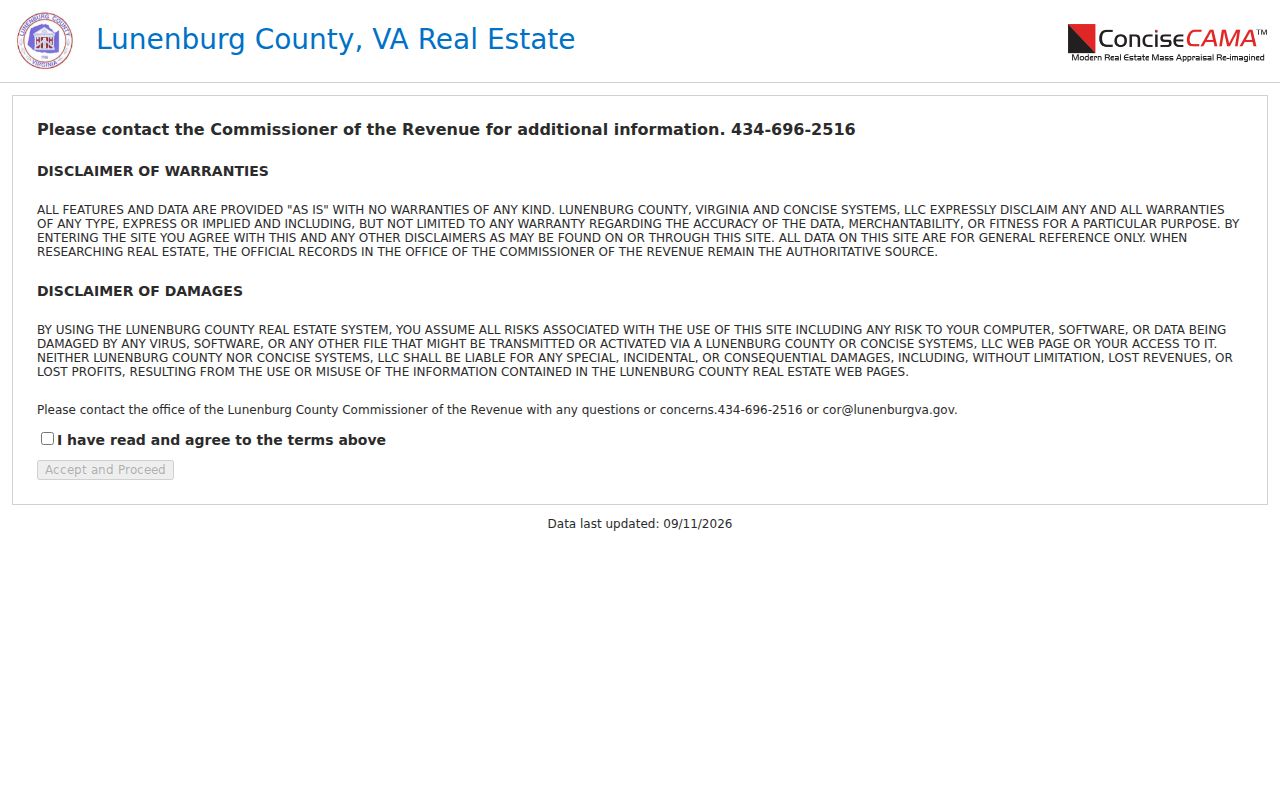
The sample shows the assessment interface itself rather than a verified example of a specific Lunenburg owner's property.
Checking the Current Owner in Lunenburg
Confirming a Lunenburg current owner works best parcel-first. Start with the assessment roll and retain its exact map key. Then search for the newest recorded instrument affecting that legal description. Do not stop at the name field. The deed date, grantee, and land description establish whether the instrument truly matches the card under review.
- Read the owner, mailing address, situs, and map number on the ConciseCAMA card.
- Search the Circuit Clerk's grantor-grantee index for the most recent matching deed.
- Compare the grantee, recording date, prior deed reference, and legal description.
- Ask the Clerk whether an image or newer filing is missing from the remote view.
- Ask the Commissioner how the assessment roll reflects a recent recording.
- Owner of record
- The name shown in the assessment roll for the parcel.
- Assessment roll
- The Commissioner's tax listing of real-property accounts and values.
- Situs and mailing
- Where land lies and where correspondence is sent; the two can differ.
- Recording lag
- The gap between a recorded deed and a later assessment display.
Lunenburg's Assessment Update Date
ConciseCAMA displays a "Data last updated" line. It shows when the online assessment system was refreshed. That date does not guarantee every recent deed is already reflected in the roll. The portal also notes that the Commissioner's office record is authoritative. Write down the displayed update date. Then check the instrument date separately. During a current owner search, the two dates can diverge by a wide margin. No published figure gives an average Lunenburg processing time from recording to roll update. Never promise that a sale will appear after a set number of days. For a recent transfer, ask the Clerk whether the deed is recorded. Ask the Commissioner when the roll is expected to reflect it. A delayed tax-card update never invalidates a recorded conveyance by itself.
Recent Deeds and Lunenburg Owners
A newly recorded deed can name the current grantee. The assessor's online card may lag behind it. The newest deed is the stronger source for a just-completed transfer. An older assessment row lags behind. Check that the instrument describes the same tract. An owner may transfer one lot and keep another. A deed's prior reference can locate the earlier vesting document when the names differ. Virginia SRA supplies the index route. Lunenburg's remote image setting and oldest year are not published locally. Inspecting the instrument may require the Clerk's courthouse terminal or copy service. This present-tense check differs from reconstructing a full chain of former owners. It stops once the newest conveyance and the assessment entry agree. The full lookup sequence for a Lunenburg property owner begins with the address-to-parcel method.
Entity Names on a Lunenburg Roll
The current owner field may name an LLC, a trust, a life tenant, an estate, an executor, or an administrator. Read the deed's vesting clause. It states the capacity in which a person or entity holds the interest. A registered agent is a company contact. That agent is not necessarily anyone who owns or occupies the land. SCC CIS can add entity context, but the deed and assessment record decide the parcel connection. A deceased owner raises different questions. The answers come from the probate file, the fiduciary appointment, a court order, or an executor's or administrator's deed. A death certificate supports identity, but it does not transfer land. When a name changes, match the legal description. Also match any prior deed reference instead of trusting a surname alone.
Mailing and Situs in Lunenburg
The mailing address on an owner card is a tax-mail destination. It may fall outside Lunenburg, belong to a representative, or carry a town or post-office label that differs from the land's jurisdiction. The situs address describes the parcel itself. These fields can diverge for ordinary reasons. Neither one is an occupancy claim. Match records by map number and legal description instead. Verify a ZIP with USPS. Confirm a town-edge parcel against the charter boundary and zoning map. Virginia runs an Address Confidentiality Program alongside other protected-address rules. Never use a mailing field to find or confront an occupant; send any legitimate record question to the custodian office.
When Lunenburg Owner Data Differ
Compare the dates first. Then compare the parcel description. The CAMA card and a deed sometimes show different names. The tax roll can lag behind a recording. A deed may also cover only part of an account. Fiduciary filings add another wrinkle. A trust or estate often appears under a trustee. It can also appear under a personal representative. The legal description may not line up. Never assume the deed involves the same parcel. A matching surname is not enough.
Call the Clerk with the instrument reference and ask whether a later filing exists. Then call the Commissioner with the map number. Ask how the assessment owner was sourced. The public portal shows a data date but no stated synchronization schedule between the two systems. Treat a mismatch as a record-confirmation issue, not a reason to infer hidden ownership.
Keep two clocks separate: the recording date and the assessment update date. A deed can be indexed before the Commissioner refreshes the online card. A tax payment can post without changing the grantee at all. A newer instrument may cover just one of several lots. Its name will not replace the owner on every card tied to the same mailing address.
Give offices what they need to reconcile a record. Bring the map key and the instrument number. Bring the book and page too. Add the recording date and the legal description at issue. The Clerk can confirm a filing; the Commissioner can explain the assessment roll. Neither screen alone settles every question about a full title chain or who occupies the property.
Limits on Contacting a Lunenburg Owner
An assessment mailing address says nothing about who lives at the parcel. It is not an invitation to approach the place. Route every parcel, assessment, or deed question through the official office channel. Virginia law and confidentiality protections can limit disclosure of some residential addresses. The Address Confidentiality Program gives eligible participants a designated substitute address.
A current owner lookup supports property diligence, tax review, estate research, and civic purposes. It does not authorize trespass or unwanted contact. Use the Commissioner for an unclear owner field. Use the Circuit Clerk for a transfer. Use the Treasurer for a tax account.
Lawful use. Handle Lunenburg owner information with care. Do not use a public record to stalk, threaten, harass, or harm anyone.