
Recorded Deeds in Lunenburg
The Lunenburg Circuit Clerk is the office that records instruments affecting title. A deed transfers a stated interest and nothing more. It does not promise that no older lien, easement, boundary dispute, or unrecorded claim lurks in the chain. A deed of trust works differently; it secures a loan. A later release or satisfaction shows that the debt behind it was cleared. Read the whole instrument. Note the parties, the date, the legal description, the signatures, and the recording reference before trusting any single document.
| Deed Type | What It Does | Common Use |
|---|---|---|
| General warranty deed | Conveys the described interest with the deed's stated warranties | Reviewing a transfer and its covenants |
| Special-warranty deed | States limited warranties as written in the instrument | Reading a conveyance with narrower assurances |
| Quitclaim deed | Conveys whatever interest the grantor holds | Checking a family or corrective transfer |
| Trustee's deed | Records a trustee's conveyance under the document authority | Following a trust or sale process |
| Executor or administrator deed | Shows a fiduciary conveyance from an estate | Connecting probate and land records |
The index reaches far beyond simple deeds. Lunenburg records also cover deeds of trust, assignments, releases, easements, rights-of-way, boundary-line agreements, subdivision plats, correction deeds, judgments, liens, and lis pendens. Each entry explains a transfer or a burden. Not all of them change ownership. A release belongs beside the original deed of trust it retires. An assignment can swap the beneficiary on a loan while the owner of record stays the same.
Lunenburg SRA Index and Images
The Secure Remote Access system is run by Virginia's Circuit Court. It serves as the remote doorway into Lunenburg land records. The state's SRA rules let a local clerk turn on free index-only searching. Images are another matter. A clerk-authorized subscription, a signed agreement, and fees may all apply. A remote image may be unavailable. An old book may sit offline too. In those cases, the Clerk's courthouse remains the fallback. The earliest online year is not published for Lunenburg. Dropdown options, result caps, and local image fees are not published either. Ask the Clerk four direct questions. Is the index remote? Are images remote? What year range is searchable? Also ask what a plain or certified copy costs. A statewide access statement does not guarantee identical settings in every county. The Virginia courts SRA access notice spells out the split. It covers free indexing and paid image subscriptions.
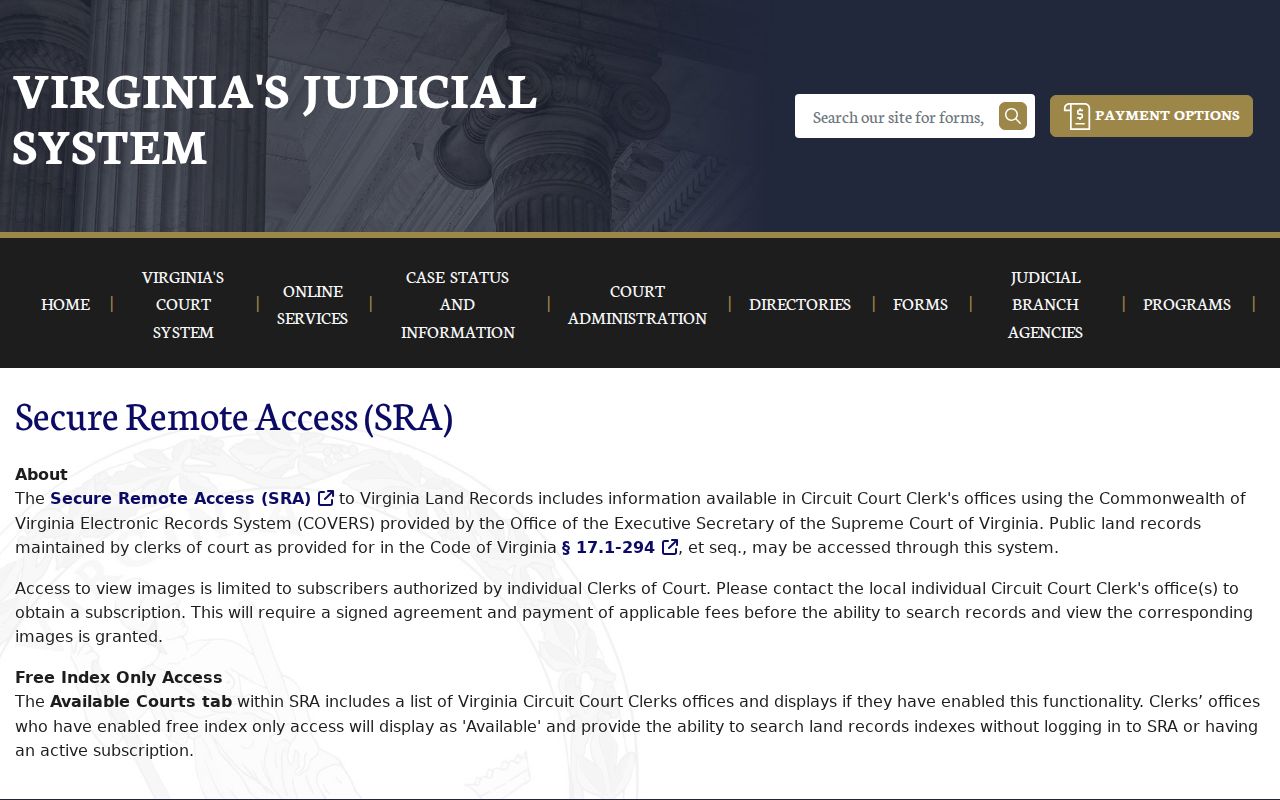
The access screen lays out the statewide model. Confirm Lunenburg's active setting and any charges with the Circuit Clerk before you order copies or subscribe.
Walking the Lunenburg Grantor-Grantee Index
Every deed has two sides. The grantor gives up an interest; the grantee receives it. To trace a Lunenburg parcel, search the likely current owner as grantee first. Open that instrument and note the grantor and the prior deed reference. Then search that earlier grantor as grantee in the years before the transfer. Repeat the walk only after the legal description matches. One person may own several tracts, and parcels get split or combined over time.
- Search the name as grantee to locate a likely acquisition deed.
- Read the grantor, transfer date, legal description, and prior deed reference.
- Search the grantor as grantee for the earlier conveyance, matching the tract each time.
- Record book and page or instrument reference, then ask the Clerk about any gap or older volume.
- Grantor
- The party named as conveying an interest in an instrument.
- Grantee
- The party receiving the stated interest.
- Chain of title
- The linked sequence of recorded conveyances for the same tract.
- Book and page
- A volume and page reference; use the local index's exact citation.
Lunenburg Deed Search Fields
What search controls you get depends on Lunenburg's own SRA configuration. Statewide guidance describes land-record access in general terms. It does not describe the exact local form. Work within the live index. Start with a search of parties. Then narrow by date, document type, parcel, or book reference when those fields appear. A field you saw in another circuit's system may not exist here. Do not assume it does.
| Index key | What it identifies | Practical check |
|---|---|---|
| Grantor | Party conveying an interest | Search name variants and fiduciary roles |
| Grantee | Party receiving an interest | Use the deed's exact spelling |
| Instrument type | Deed, release, plat, lien, or other filing | Use only options present in the live Lunenburg form |
| Date or book reference | Period and recorded citation | Ask the Clerk to confirm the searchable year range |
A Lunenburg deed index row may list a party, a document type, a date, and a recording reference. Image access varies with the Clerk's settings. If a key detail is missing from the online result, ask at the courthouse for the matching index or book.
Historic Lunenburg Deed Books
Lunenburg County formed from Brunswick in 1746. Any land trail before that date crosses into the parent county and the colonial patent records. The Library of Virginia's preservation award list names Lunenburg Deed Book 16, covering 1790 to 1795, as a concrete starting lead. That single citation does not map the full book run, the custody, or what is online. Ask the Clerk or the Library of Virginia where a particular volume and its index are held. Older deed books, plats, survey books, road orders, land books, and tax lists may sit in a courthouse vault. They may have moved to the state archive. Or they may be described in a finding aid. No courthouse fire or wholesale loss of records appears in the county's own materials. When an online index returns nothing, treat it as a custody question, not proof the deed never existed. The Lunenburg ARVAS collection finding aid includes land-adjacent tax and court material from 1802 onward.
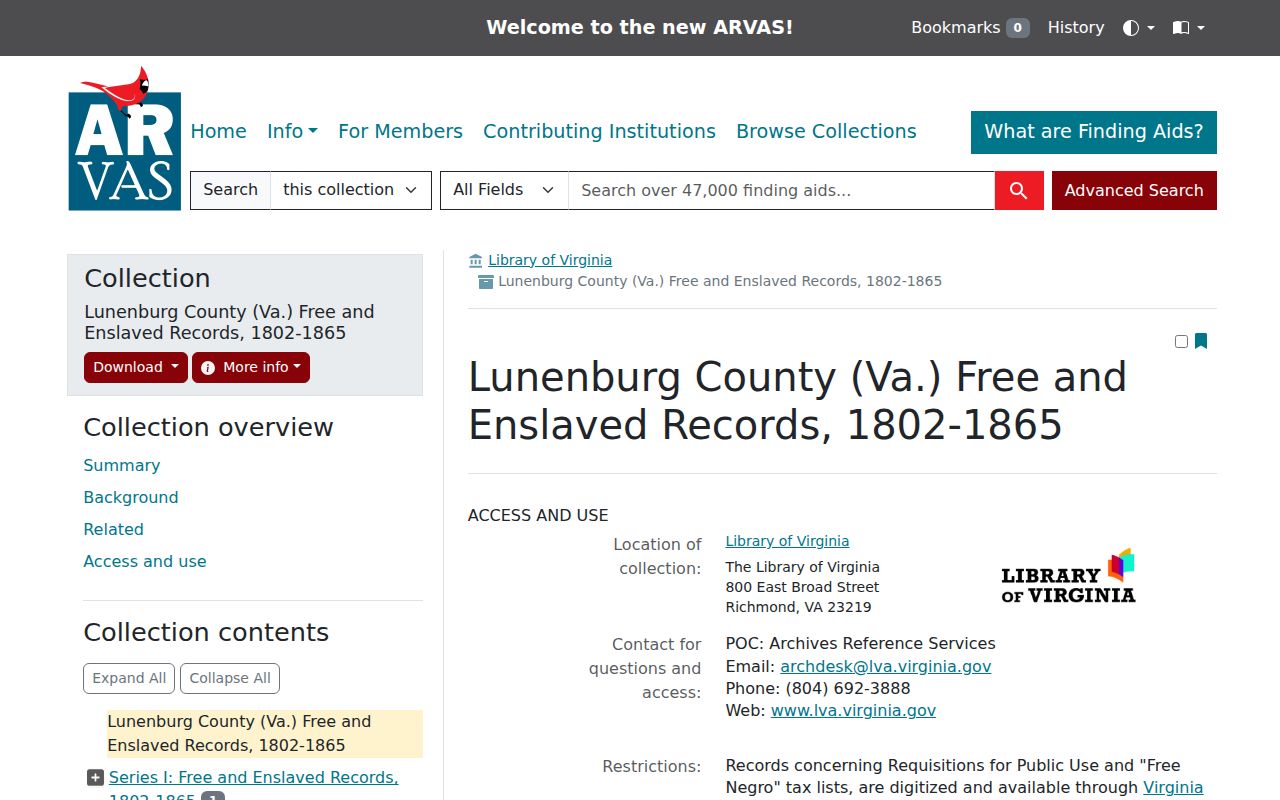
An archive catalog is only a locator. Tie its names and dates to the deed's legal description before linking anything to a modern parcel.
Estate Deeds in Lunenburg
An owner who dies leaves a name on the land index. That name may shift in several ways. A will, a probate order, a partition, or a conveyance by heirs can each move title. The will itself only states an intent. The executor's deed or the recorded court order is what does the work. It is what actually enters a land instrument into the public chain. Run the probate file and the land index as two separate searches in Lunenburg. An estate label on the assessment roll is often temporary. Treat it as a placeholder, not the final owner of record.
When a deed names an executor or administrator, read the authority cited in the document. Compare the parcel's legal description with the assessment card. Archived files need the estate name, decedent, death year, fiduciary, and archive reference. The Circuit Clerk can help locate them. VDH holds current death certificates and limits access to them. A certificate supports identity. It is not proof of title.
Lunenburg Liens and Releases
Deed records in Lunenburg carry more than sales. They hold deeds of trust, assignments, modifications, satisfactions, judgment liens, mechanic's liens, easements, rights-of-way, boundary agreements, and lis pendens. Search them by party name and tract description. An assignment can swap the secured party while the owner of record stays the same. A release belongs to its original instrument by reference. Read it as a partial, never a fresh conveyance.
A blank in an online index proves little. It does not mean a debt went unpaid, nor that it was cleared somewhere else. Request the instrument image. Have a title professional examine the full chain before drawing conclusions. SCC filings of UCC and federal tax liens can round out business research. Real-estate instruments themselves stay with the Lunenburg Circuit Clerk.
Lunenburg Tax-Sale Conveyances
A tax-sale question in Lunenburg touches four places. The Treasurer account holds a piece. The Circuit Court equity file, the notices, and the land index each hold a piece. Virginia Code § 58.1-3965 governs judicial delinquent-tax sales and redemption. No delinquent list, sale calendar, or auctioneer appears on official web sources. Ask the Treasurer and the Clerk directly. Ask for any existing case or notice records and their dates.
A notice is not a conveyance. The court order tells part of the real story. The parties, service, redemption history, and the later recorded deed tell the rest. Give a tax-sale deed the same legal-description scrutiny as any instrument. A proposed purchaser or an old assessment owner proves nothing. Land changes hand only when the deed records say so.
Requesting a Lunenburg Deed Copy
Start a newer deed search in the SRA index. Note the parties, date, document type, and book/page or instrument number. If the image is missing, call or visit the Lunenburg Circuit Clerk at 11435 Courthouse Road, Lunenburg, VA 23952, telephone (434) 696-2132. The court page lists hours of 8:30 a.m. to 4:30 p.m. Call ahead for an older book, archived case, plat, or certified copy.
A written request works best with precise details. Identify the instrument as closely as you can. State whether you need a plain or certified copy. Ask the Clerk to quote the current fee and accepted payment method. The statewide deed-fee PDF has returned a 404, so skip any stale figure. Virginia FOIA reaches existing administrative records, but deed copies follow the Clerk's own land-record process. The official Lunenburg Circuit Court page is the source for the Clerk's address and contact details.
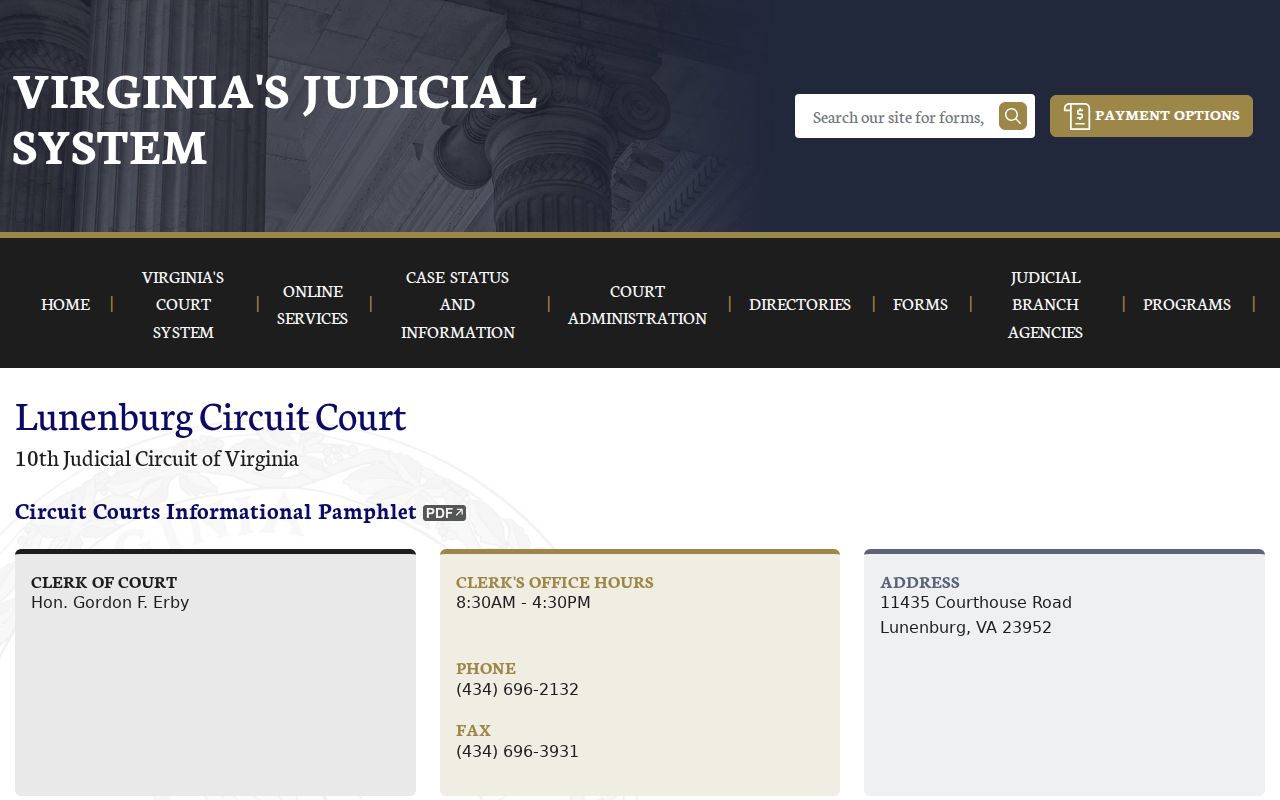
Confirm the current service details with the court before a trip or copy request.
Recorded, not guaranteed. A Lunenburg deed index points to documents placed in the public record. It is not a title opinion, and a complete title review may need older books, releases, court orders, and professional judgment.