
Value Types in Lunenburg Records
Lunenburg assessment cards and deeds offer two kinds of value evidence. The CAMA card can show land value, improvement value, total assessed value, and sale history. Those fields appear on some cards but not all. A deed is different. It records a conveyance and may state the consideration paid. Market value is yet another question, and no assessment card certifies it.
| Value | What It Is | Where |
|---|---|---|
| Assessed value | The assessment roll figure used in local valuation records | Commissioner of the Revenue / ConciseCAMA |
| Market value | A separate estimate of likely sale value, not certified by the tax roll | Independent appraisal or market analysis |
| Sale consideration | Amount stated for a recorded conveyance, if the instrument reports it | Circuit Clerk deed and any card field shown |
| Land and improvements | Assessment components, when each is displayed | ConciseCAMA assessment card |
An assessed value is a tax-roll figure, not a sale price or an appraisal. One recorded sale reflects its own conditions. It cannot set market value for a different parcel or a different date. Lunenburg publishes no parcel-specific assessment ratio. Nothing in the county record amounts to an appraisal guarantee.
Lunenburg Assessment Values
The ConciseCAMA portal is the current online route to Lunenburg assessment data. The Commissioner of the Revenue treats portal values as reference information. The official office record controls. A parcel card may show the map number, situs, legal description, land value, improvement value, and a total. Each field appears only when present. Note the update date and the exact tax year attached to any number.
The portal lists its own data-update date. That date describes the online screen, not the timing of every deed or appraisal. A recent conveyance may not appear right away. Confirm the instrument with the Circuit Clerk. Ask the Commissioner when the assessment record will reflect it.
The ConciseCAMA disclaimer identifies the official assessment record.
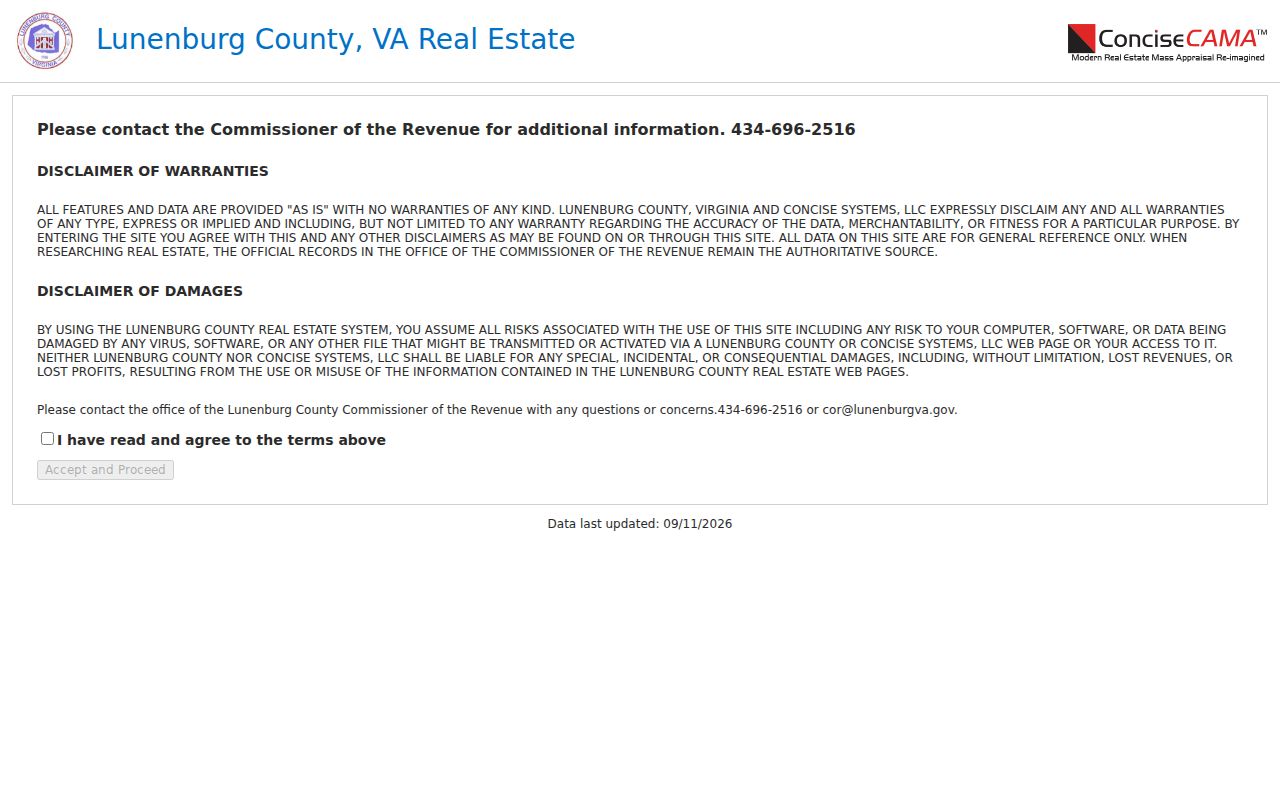
Treat the online value as a starting point. For a disputed field or assessment year, ask the Commissioner directly.
Finding a Lunenburg Assessed Value
Search by the property's situs address in ConciseCAMA. You can also fall back on the owner and map controls. Open the likely card and compare the legal description before copying any value. Two Lunenburg parcels can carry similar names, and that check prevents mix-ups. The portal does not promise every field on every card.
- Search by address or owner in the Lunenburg assessment portal.
- Confirm the map number and legal description match the parcel.
- Record land and improvement values, total assessed value, and displayed year only when present.
- For sale evidence, locate the recorded deed and read any consideration field in the instrument.
- Ask the Commissioner to confirm the value basis if a field or year is unclear.
- Assessed value
- The figure listed on the county assessment roll for the parcel.
- Market value
- A separate estimate of value in an open market.
- Sale consideration
- The amount stated in a deed when the instrument reports it.
- Reassessment
- A later review or update to assessed values; ask the Commissioner for the local cycle.
Lunenburg's 2024 Value Change
A county notice reported total assessed real property of $954,775,100 for 2023. The 2024 figure was $1,213,946,300. That is a 27 percent countywide increase. The notice also discussed a proposed $0.33 per $100 rate. It mentioned a lowered or equalized $0.30 per $100 rate as well. Those are countywide totals and rate context. They are not a value change for every Lunenburg home or tract.
For one Lunenburg property, compare the individual card across years. Keep assessed value separate from sale evidence. Countywide totals can rise while individual parcels move by different amounts. The county publishes no separate value series for Victoria or Kenbridge.
Sale Evidence for Lunenburg Property
A deed can supply a recorded transfer date, the parties, the legal description, and the sale consideration. The consideration appears only when the instrument states an amount. Assessment cards sometimes show a last-sale date or value field. Check what the live card actually displays. If the field is absent, never assume the consideration was zero. Also never assume the property never sold.
A sale price is evidence of one transaction, not an appraisal of current value. Timing, condition, included land, and other terms can all hide inside a single number. Compare the instrument against the current assessment record. Keep the deed reference so anyone can retrace the source.
The Lunenburg deed-records search explains how to locate the recorded instrument.
Land and Improvement Values
ConciseCAMA may separate land and improvement values on a parcel card. That split shows how the assessed total is built. It is not a condition report or a contractor's estimate. A card may include physical details. It may show a sketch, photographs, or year built. Describe those items only if they appear on the selected record. Not every card displays them.
For a sound Lunenburg comparison, record the same fields for each parcel and year. A land-only tract and an improved town lot are not direct comparables without adjustment. The tax office or an independent appraiser can explain the valuation methods. The public assessment screen does not establish what a buyer would pay.
Assessment Cycle in Lunenburg
Virginia assesses on a six-year cycle, according to a 2025 survey by the Virginia Association of Assessing Officers. That figure is statewide context. It does not set a firm reassessment date for every Lunenburg parcel. Before comparing values across years or planning a formal review, confirm the cycle with the Commissioner of the Revenue. That office holds the local assessment calendar.
A reassessment resets the tax-roll basis for value. It cannot tell an owner exactly how a future bill will move. The rate, the account, any exemptions, and land-use treatment each play their own part. For bill totals, payment history, or contest procedures, rely on the Treasurer and Commissioner records. Do not treat one assessed-value figure as a full tax calculation.
Remember that a six-year interval is a state pattern, not a promise of a uniform anniversary for each Lunenburg parcel. The county publishes no current assessment calendar. It offers no phased schedule, and no parcel-specific effective date appears in its public materials. Ask the Commissioner which valuation date and cycle govern the exact tax year you are comparing. Parcel records carry their own year labels.
When a number changes, keep copies of both cards. Note whether the movement came from land, improvements, a parcel split or combination, or a changed exemption field. Those components shift for different reasons. The county's 27 percent total increase for 2024 is a countywide figure. Never apply it to a single tract as a shortcut; compare only that parcel's own record and year labels.
Exemptions and Lunenburg Values
An exemption or land-use flag changes how a parcel is taxed. Lunenburg publishes no complete exemption list or application guide in its public property records. Record only a flag the live assessment card actually shows. Ask the Commissioner what it means for that parcel and year. Ask whether a separate approval record exists for the file.
Assessed value and taxable value are not synonyms once an exemption or special land-use record enters the picture. Value numbers have their own meaning and source. Bill computation and payment status belong to the Treasurer. See Lunenburg property tax records for the account and bill route.
Limits of a Lunenburg Property Value
A Lunenburg assessed value is a tax-roll figure. It may lag a recent sale or miss current market conditions. It is not an appraisal, an offer, or a guaranteed price. The portal can also trail a newly recorded deed. A countywide increase says nothing exact about one parcel. Use every number with its field name, year, and source attached.
Value vs. price. An assessment supports local tax administration. A licensed appraiser or qualified market analysis is needed for a sale-specific opinion of value.