
Finding Who Owns a Lunenburg Property
An address works fine as a first clue. Use both. From there, move to a parcel key that stays stable across Lunenburg County records. ConciseCAMA supports owner and address searches and includes map controls for insert, double circle, block, lot, and sub-lot. The owner field reflects the current assessment roll. A deed index entry, by contrast, records the instrument that conveyed an interest, and the two can disagree after a recent recording or when land sits inside an entity.
- Search the address or owner name in ConciseCAMA and note the displayed owner and map number.
- Use that exact parcel key to check the tax account and identify the land description.
- Search the Circuit Clerk's grantor-grantee index for the newest deed affecting that tract.
- Compare grantee, recording date, and legal description with the assessment result.
- If a business name appears, check SCC entity details as context, then verify the deed itself.
Sources for Lunenburg Owner Information
Lunenburg records name owners for different reasons. ConciseCAMA shows the assessment owner and mailing fields. The Clerk's land index lists the parties to each recorded instrument, while the Treasurer ties a name to an account or payment. A parcel map service gives a map reference, not a definitive ownership display. Read each result with its custodian and date in mind.
| Source | Owner Info It Gives | Access |
|---|---|---|
| ConciseCAMA roll | Assessment owner, mailing address, situs, and map key when displayed | Online reference; Commissioner record controls |
| Circuit Clerk land index | Grantor and grantee on a recorded instrument | SRA access varies; courthouse fallback |
| Treasurer account | Name connected to a tax ticket or payment | e-Treasurer inquiry; not title evidence |
| SCC CIS | Business entity and registered-agent context | Public entity search; does not prove parcel ownership |
Owner of record names one record's listing. A grantee received the interest stated in a deed. Neither term tells you who occupies the building. A situs address marks where the parcel lies, while a mailing address shows where assessment mail goes in Lunenburg County. Those two fields can be different without signaling any kind of error in the record.
Owner Fields in Lunenburg CAMA
ConciseCAMA's disclaimer is blunt. Online data are supplied as-is. The Commissioner's official records stay authoritative, and the portal posts a data-last-updated date for the web copy. That date does not certify title or prove a recent deed reached the roll. Read the owner and mailing labels on the live card, then call the Commissioner at (434) 696-2516 or email cor@lunenburgva.gov if a field is unclear.
Keep the map number. Keep the legal description and any deed reference too. A missing field on the page does not mean the Lunenburg County office lacks the record. Ask for the official card or the missing value. That separates a display limit from a true record gap. The portal disclaimer names the Commissioner as the authority.
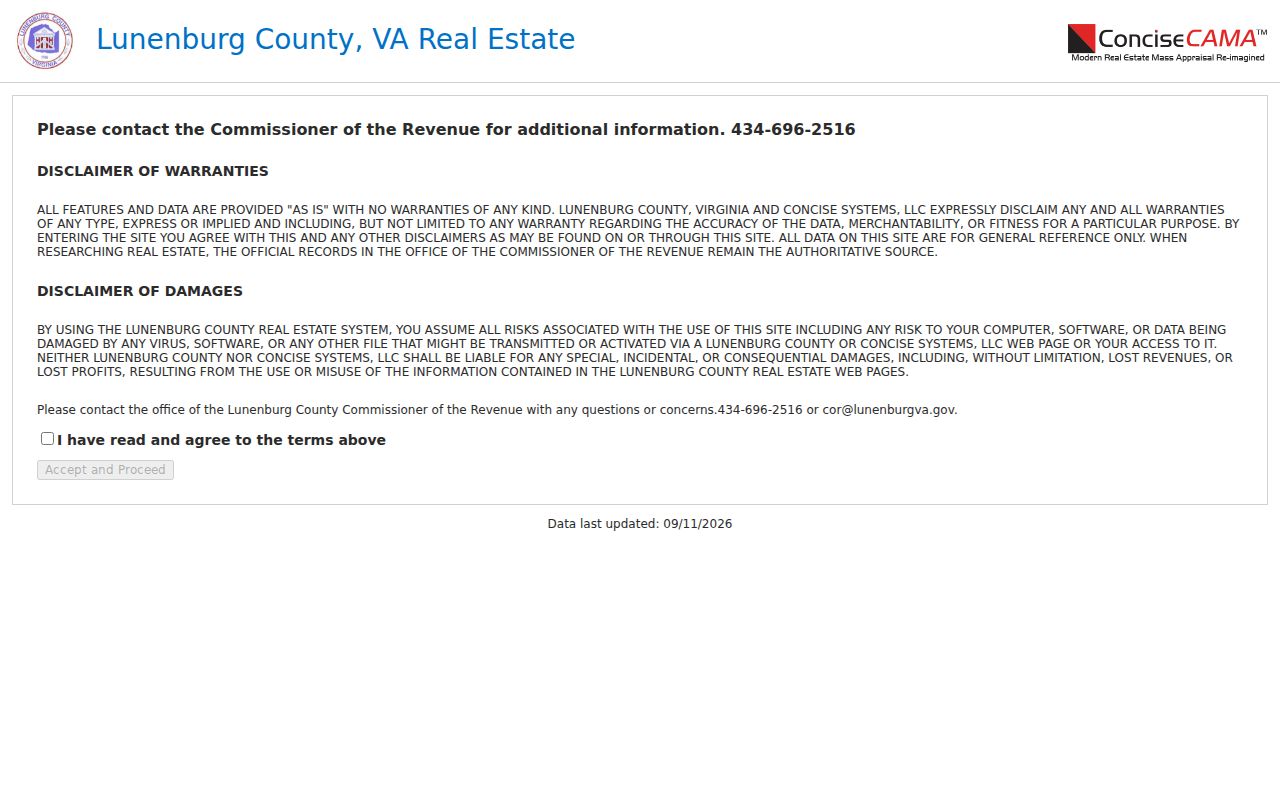
The disclaimer exists for a reason. Verify the name with the Commissioner instead of treating an online row as a certified title result for a Lunenburg parcel.
Lunenburg Mailing and Situs Names
A Lunenburg mailing address can be a post-office box, a business, an out-of-county location, or a fiduciary's office. It is where mail goes. It does not prove residence or occupancy. The situs line describes the parcel being assessed. Rural route labels and town names can shift between the assessor, Treasurer, deed, and postal record.
For identification, compare the map key and deed description. A mailing address is not a location pin. For contact or safety concerns, use official channels and respect privacy protections. Virginia's Address Confidentiality Program and protective-order rules can restrict certain addresses. A missing or alternate mailing field should never prompt an effort to uncover a protected location.
Confirming a Lunenburg Deed
For a recorded interest, the deed comes next. Search the likely grantee first. Open the instrument and compare the grantor, grantee, recording date, legal description, and prior deed reference. The Clerk's index locates the filing, and the recorded image supplies its wording. If images are not available remotely, ask about the courthouse terminal or copy process.
The statewide SRA system may offer a free index where enabled, with subscription-based images. The county publishes no index cutoff or image settings. Confirm the year range and access route with the Clerk. Timing matters here. A new deed can be recorded before the assessment roll changes, so a recent transaction calls for a date comparison. The Lunenburg deed-records page details the copy route.
Entity Owners Around Lunenburg
Sometimes a Lunenburg County deed or tax roll lists a company instead of a person. A registered agent is not automatically the landowner. Virginia SCC CIS helps by showing an entity's status, formation details, agent, and principal office. Match that legal party to the parcel through the deed and the assessment record. UCC and federal tax-lien filings address liens, not the deed chain.
Trusts need the same care. A trust, life estate, or estate may name a trustee. It may also name a personal representative in the instrument. Read the capacity printed after the name. Note any referenced authority. A probate file can explain an executor's role. A recorded executor or administrator deed shows the conveyance placed in the land record. A name match alone proves little.
Use the Virginia SCC CIS and UCC portal as the official entity-search interface.
Entity filings add useful business context. To connect a company to a specific parcel in Lunenburg County, you still need the deed and the county assessment card.
Recent Owner Changes in Lunenburg
A closing, a recording, an assessment update, and a tax-account change do not happen at once. Each lives in a different system. The Lunenburg Commissioner portal displays a data-last-updated date, but no source states an average lag between recording and a roll update. So a recent deed can appear in the Clerk's index. Meanwhile the CAMA screen may still carry the older name.
Compare the dates. If the newest recorded deed names a different grantee than the assessment card shows, ask the Clerk whether the image is complete. Ask the Commissioner about the roll update. Never guess a local processing period. For a current-owner question, the latest recorded instrument and legal description carry more weight than an older tax mailing field.
Keep three dates separate on any parcel that just changed hands. One is the date the parties signed the deed. Another is the date the Clerk recorded it. The third is the date on the assessment card or the online update marker. If a name shows up in more than one form, search the exact grantee spelling first, then check punctuation, estate or trust capacity, and any company suffix against the instrument.
A solid owner match takes two things. It needs a person or entity name plus the same tract description. Lunenburg's map number helps. It links CAMA, the Treasurer, and the parcel layer. On its own it proves nothing about ownership.
When the address and owner searches point to different parcels, use the deed's legal description and its cited prior instrument to decide which record continues the chain. The owner-record details and date comparisons continue on the Lunenburg current owner page.
Limits of a Lunenburg Owner Search
A public owner field has firm limits. It does not confirm an occupant, a full title chain, or a parcel boundary. The Lunenburg County roll can lag behind a new deed. The deed index may take extra digging to surface a fiduciary or corporate variation. And a mailing address is not proof of residence.
For a title opinion, rely on a title company or attorney. Boundary questions belong to a surveyor. Virginia law also restricts stalking and harassment, and some addresses are protected by statute.
Property research fits due diligence, tax review, estate work, and civic purposes. It grants no permission to pressure anyone. Never target a person named in a Lunenburg County record.
Lawful use. Use a Lunenburg owner lookup for lawful property research. Do not use a name or mailing address to stalk, threaten, harass, or harm anyone.