
What Lunenburg Property Tax Records Show
Lunenburg splits tax work between two offices. The Commissioner of the Revenue keeps assessment records in the ConciseCAMA portal. The Treasurer's e-Treasurer system covers tax tickets, bills, and payment. Read the field label and year before comparing numbers. An assessed value is not a payment amount. A payment entry never proves a deed transfer.
| Field | What It Shows | Where |
|---|---|---|
| Assessment owner and map key | Name and parcel reference as listed by the Commissioner | ConciseCAMA |
| Land and improvement values | Assessment components when displayed on the card | ConciseCAMA |
| Exemption or land-use flag | Only a field shown on the live assessment result | ConciseCAMA or Commissioner |
| Tax ticket and bill detail | Account, ticket, amount, and bill information | e-Treasurer |
| Payment history | Yearly or transaction history available in inquiry | e-Treasurer |
The assessment portal carries a plain warning. Its online data are reference only. The Commissioner's office record remains the authoritative one. Use e-Treasurer as a transactional tool instead: review a bill or payment there, then return to the assessment card for land and improvement fields. The exemption list and every local bill field are not published in the help pages.
Finding a Lunenburg Tax Bill
Start a bill search with one known key. The Treasurer's help lists a parcel, a name, an account, or a department-and-ticket pair as separate modes. A name search may return a list first. Pick the matching account and open the bill detail. The public inquiry page also toggles between a description view and a map-number view, and it pages through longer result sets.
- Search by parcel number when the ConciseCAMA card supplies it.
- If needed, switch to name, account, or department and ticket number.
- Select the matching account and review the bill or payment-history detail.
- Compare the description or map number with the assessment card before treating it as the same parcel.
- Assessed value
- The local roll's value entry; it is not a sale price or a payment.
- Tax ticket
- The Treasurer's account reference used to find a bill.
- Payment history
- Recorded payment activity tied to the selected account.
- Tax lien
- A recorded or statutory claim related to unpaid tax; check the actual file.
Lunenburg Treasurer Search Modes
The e-Treasurer help gives a practical field list for any Lunenburg tax lookup. Department and ticket number form a paired key. Parcel number, name, and account number are separate choices. The inquiry screen can also switch between a plain account description and a map-number view. Use one exact key at a time. Keep the account reference so a second search can be checked against the same parcel.
| Search mode | What it finds | Check before use |
|---|---|---|
| Department and ticket | A specific tax ticket | Keep both values together |
| Parcel number | Tax account tied to the map key | Copy the identifier from CAMA |
| Name | Possible account matches | Choose the correct result from the selection list |
| Account number | One account route | Compare the description with the parcel card |
The Treasurer's real-estate payment help describes the search and payment flow.
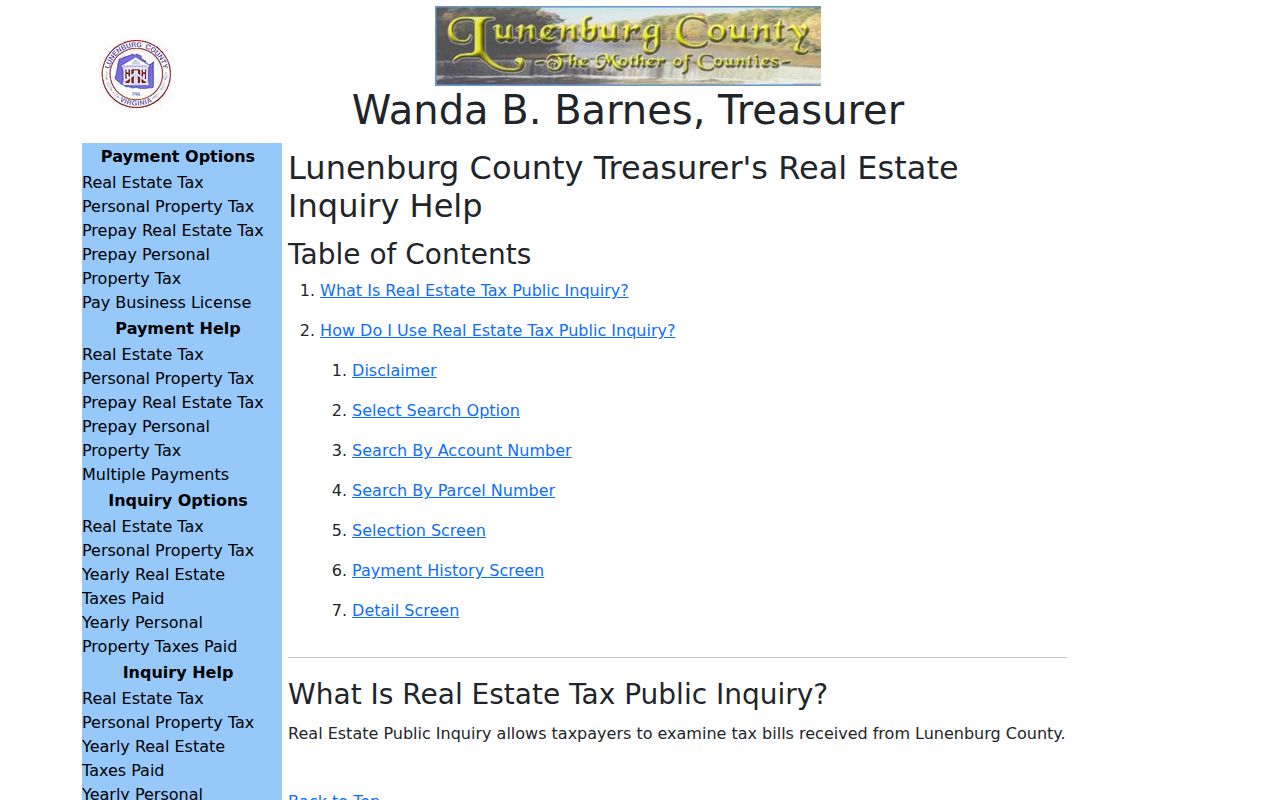
The Treasurer's public inquiry page displays its description and map-number controls together. Use them to line up a tax account with its parcel card. Inquiry and payment are distinct actions. The real-estate inquiry screen exists to inspect an account and its history. The separate e-Treasurer service provides the path to pay. Card payments there carry a fee. The county help page states 2.25 percent for the online card transaction. That fee covers only the online transaction, not every way of asking the Treasurer about a parcel. Confirm the amount at checkout before submitting payment.
Same-name results need extra care. Open only the account whose parcel description or map number matches the assessment card. Record the tax year, the ticket, the parcel key, and whether the screen shows a charge, payment, or balance. A payment by an owner, agent, lender, or any other payer transfers nothing. It does not prove a deed was recorded either.
A Lunenburg tax inquiry reproduces best with careful notes. Write down the mode as well as the search term. A ticket number without its department, a surname without a parcel number, or a result page left on the wrong description view can invite a false comparison. Keep the year, the account or ticket reference, and the map number handy before returning from Treasurer data to the assessment roll.
Payment questions and title questions call for different records. Ask the Treasurer to confirm the account history for the year in question. Then turn to the Circuit Clerk's deed record. An account can show tax money was received. It cannot certify that every charge was paid, that no lien exists, or that the payer gained any interest in the land. That answer belongs to the recorded deed.
Keeping Lunenburg Assessment Separate
ConciseCAMA and e-Treasurer are two views of one parcel system, not a single record. The Commissioner sets and maintains assessment information. The Treasurer tracks the tax account and money received. Another person can pay the bill. That payment conveys no title, settles no boundary, and updates no deed chain.
ConciseCAMA's disclaimer says the web data come as-is, may be inaccurate, and answer to the official record in the Commissioner's office. The update date is only a freshness signal. A recent purchase complicates the roll. The recorded deed may be newer than the owner field, so ask each office which date its own system reflects.
Lunenburg's 2024 Tax Context
Lunenburg County's 2024 notice tells a story in numbers. It reported $954,775,100 in assessed real property for 2023. For 2024, the figure climbed to $1,213,946,300, a 27 percent countywide jump. The same notice weighed a proposed rate of $0.33 per $100 against a lowered or equalized rate of $0.30 per $100. Those are countywide totals, though. They say nothing about any single Lunenburg parcel's bill.
Checking one parcel takes two records. Pull the assessment card first. Compare its land and improvement values year by year. Then open the related Treasurer account for the actual bill and payment history. A rising assessment total does not push the tax bill up by the same percentage, so read the real rate and account details for the tax year you care about. If a value looks wrong, ask the Commissioner which review path applies.
Exemption Fields in Lunenburg
No complete Lunenburg exemption list or online application route is published. The ConciseCAMA sample-result inventory records an exemption or land-use flag only when the live card displays one. An empty field proves nothing. It does not mean no benefit was approved. It also does not mean a statewide program applies to a specific parcel.
Go straight to the Commissioner instead. Ask what exemption or land-use program sits on the account. Ask what documentation it requires. Ask whether the office keeps a separate application or approval record. For a past year, name the exact tax year and parcel number. The Treasurer can explain the bill amount and payment status. The Commissioner remains the source for assessment fields and how an exemption is recorded.
Lunenburg Delinquent Tax Records
Lunenburg's e-Treasurer interface handles payment inquiry and yearly paid history, but the county publishes no public delinquent-tax list online. Ask the Treasurer directly whether a delinquent land-book list or account report exists and what years it spans. A bill that looks unpaid in one view deserves a call to the account custodian before anyone calls it delinquent.
Judicial tax sales of real estate in Virginia rest on Code § 58.1-3965, which sets out notice, a Circuit Court bill in equity, and redemption rights. The owner can redeem before sale by paying the statutory amounts plus costs. Confirm any pending case, newspaper notice, and auctioneer with the Clerk and the Treasurer.
A notice or an old assessment name proves nothing about a completed sale. Only the court order and the later recorded deed carry that weight.
The Treasurer's online pages offer payment and inquiry functions but no public list of delinquent parcels and no sale calendar. If a title review raises a tax concern, pull the account history for the exact year and ask whether a separate delinquent land-book list exists. The Circuit Court file, along with any recorded trustee or purchaser deed, is separate evidence; review it all before concluding a sale changed title.
Challenging a Lunenburg Assessment
A Lunenburg property owner disputing an assessment starts with the Commissioner of the Revenue. Ask for the assessment basis, the local review procedure, and the required evidence. Also request the filing dates. Virginia Code § 58.1-3980 et seq. governs local assessment appeals. The county publishes no specific appeal calendar, board contact, or current form online. Confirm those details directly rather than borrowing another locality's deadline.
Any inquiry should cite the parcel's map number and the tax year. Explain which field appears wrong. Bring existing support such as a deed, plat, measurement, or record card. A gap between the assessed value and a hoped-for sale price alone is rarely enough. It will not settle the matter. The Commissioner can identify the official record and explain where a formal appeal must go.
Appeal window. The local deadline was not confirmed in the public research. Ask the Commissioner for the current Lunenburg filing date, required evidence, and review office before submitting an appeal.